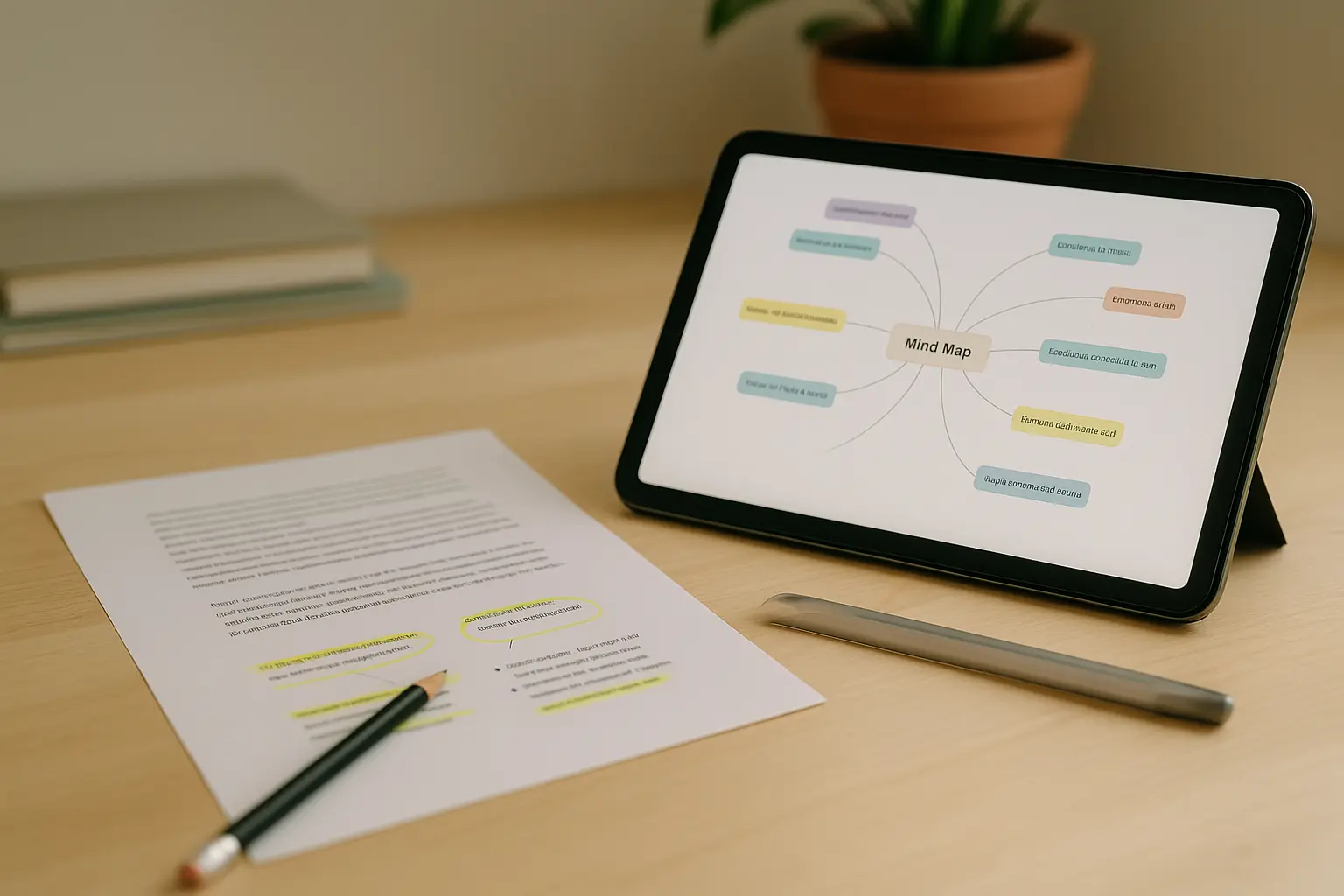
Effective studying requires tools that can adapt to how our brain processes and organizes information. Kiuwo was born with this exact goal: transforming scattered study materials into visual structures, facilitating understanding and memory.
Let's look at the five reasons why this tool can make a difference in daily study.
In brief: where Kiuwo actually reduces friction
- It brings different materials together around one topic.
It makes hierarchies and relationships visible instead of leaving them buried in text.
- It provides an editable draft to verify and use for active recall.
Different materials as a starting point
One of the most common problems while studying is scattered material: PDFs in one folder, notes in a notebook, lecture recordings in another app, and links saved elsewhere. Constantly switching between resources makes it harder to see the thread connecting the topic.
With Kiuwo, you can start from different materials, including PDFs, text, images, notes, and audio, and turn the relevant information into an editable mind map. The map provides a shared structure for viewing concepts, hierarchies, and relationships.
The benefit is not storing more files. It is building a representation that helps you navigate the material and decide which parts to verify, explore, or review.

From reading to visualization in seconds
Reading dozens of pages of handouts or notes takes time. And often, after reading, there's still the need to create a visual structure to organize all that information.
Kiuwo automates this phase: by uploading a PDF or audio file, the content will be analyzed, generating a structured mind map that shows the main concepts and their relationships.
This does not mean skipping detailed reading. It means starting with an overview of the material, its key points, and their relationships. Once the map is generated, you can decide which nodes to verify or explore.
This reduces the initial organization work, but it does not remove the reading, verification, or processing required for an exam or presentation.
Maps always linked to sources
When a map comes from indexed documents or audio, Kiuwo keeps references that let you return to the original material. A node can point to the PDF page or audio segment from which the information came.
This means that if a student wants to verify a concept, explore a detail, or check the exact context of information, they can do so immediately. There's no need to reopen the document and search manually: just click on the source reference.
Traceability is fundamental for those studying for university exams or preparing theses and research, where precision and the need to cite sources are essential.
A reference does not make a map automatically correct, but it makes it easier to check a claim, identify an inference, and correct an error.
A map you can review and adapt
An AI-generated map is a starting point, not a result to accept without review. After generation, you can revise its structure, edit nodes, and highlight the concepts that matter most for your goal.
While preparing for an exam, you can keep the definitions and steps required by the syllabus in the foreground. During exploration, you can reorganize branches to compare ideas, formulate questions, and identify points that need further investigation.
Being able to work directly on the map makes Kiuwo useful at different stages of study: first to get oriented, then to verify, and finally to review with a structure shaped around the task.
Accessibility for students with learning disabilities and special needs
For students with specific learning disorders (SLD) or special educational needs (SEN), many traditional study tools can represent significant barriers.
Kiuwo can reduce some organizational barriers by turning text and audio into an editable visual structure. Its usefulness depends on the learner's need, the map's visual load, and how it fits the study process.
The ability to customize the structure, highlight concepts, and hide secondary detail makes adaptation possible. There is no single format for everyone, so the result should be tested and corrected with the person who will use it.
Conclusion: study better, not necessarily more
Kiuwo doesn't promise to reduce study time to zero or eliminate the need for commitment, since studying always requires concentration, repetition, and deep understanding.
What Kiuwo can do is make studying more efficient: less time wasted searching for materials, less effort in the organization phase, more clarity in visualizing connections between concepts.
In essence, it allows you to dedicate more energy to what really matters: understanding, reasoning, remembering.
To choose the right format for the task, also compare outlines, summaries, and mind maps.
Frequently asked questions
No. It organizes material into a visual structure, but understanding, verification, and recall remain the learner's work.
Sources used
- Novak and Cañas, The Theory Underlying Concept Maps
- Roediger and Butler, Retrieval Practice in Long-Term Retention
- Dunlosky et al., Effective Learning Techniques
- Unsplash License

Want to transform your notes into intelligent mind maps? Discover how Kiuwo helps you organize your ideas starting from PDFs, texts, and audio.