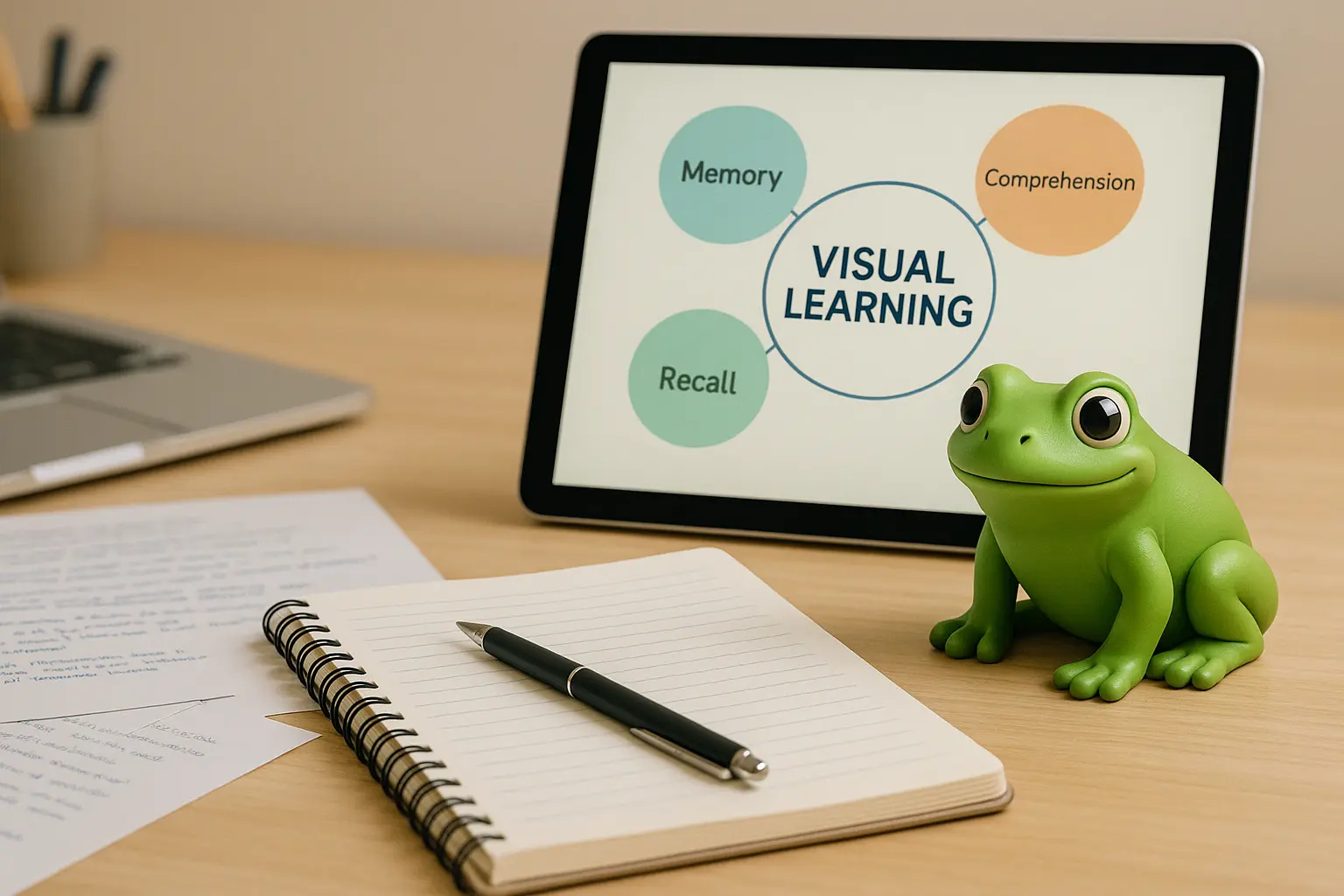
You’ve probably found it easier to remember a chart or a diagram than a list of points written one under the other. Or maybe you’ve noticed that when you look at a concept map, you can perceive connections between ideas that you didn’t see in your traditional notes.
The benefit does not come from the brain always working better with images. It appears when an external representation makes a relationship visible that would take several steps to reconstruct from prose.
A diagram can clarify a sequence; a map can expose a hierarchy. But a decorative image or crowded map does not help automatically. What matters is what the visual lets you do.
In the following paragraphs, we’ll explore how images, diagrams, and mind maps can genuinely help you think better and remember more.
In brief: when visuals actually help
When they show a relationship, sequence, or hierarchy that is hard to see in prose.
When words and images complement each other without needless repetition.
When the learner works with the visual instead of merely looking at it.
Why a visual structure can help
Text and images are not rivals. Text is precise when describing arguments, conditions, and nuance; a visual representation can show position, sequence, hierarchy, and relationships in the same space.
The benefit appears when the two forms are complementary. If prose explains a process and a diagram shows its steps, the learner can connect description and structure. If the image repeats everything or adds irrelevant detail, it can become noise.
A well-built mind map works as an interface to a topic. It does not replace the sources; it shows where concepts sit and how they connect. The value is not “understanding in seconds,” but knowing where to look and which relationships to verify.

The Concrete Benefits of Visual Learning
-
Complementary representations
Words and images can represent the same concept in different ways, but the benefit depends on the task and the design. There is no universal percentage of visual information that everyone remembers.
-
Deeper understanding
Visualizing complex concepts helps you see hidden relationships. Studying the French Revolution by reading pages of chronology is one thing; seeing a map of causes, actors, events, and consequences is another. French Revolution
-
Reduced cognitive load
Working memory is limited. A well-designed representation can expose steps and relationships; a decorative, redundant, or crowded image can add work instead.
-
Facilitates connections between concepts
Thought is not linear: it jumps, links, loops back. Mind maps respect this nature, allowing you to see how an idea branches into sub‑concepts and intertwines with other areas.
When Visual Learning Truly Helps
Not every situation requires a map or a diagram. Here’s when visual tools become truly useful:
-
When you need to synthesize large volumes of information
Have 200 pages to study for an exam? A mind map can act as your "visual index", where each branch represents a chapter and each sub‑branch a key concept.
-
When concepts are interconnected
History, philosophy, social sciences, law: disciplines where everything is connected. Visual learning excels here, enabling you to see causal, temporal, and logical relationships instantly.
-
When you have little time and need to review quickly
Before an exam or presentation, scrolling through 50 pages of notes is slow. A well‑constructed mind map lets you review the entire topic in minutes.
-
When another structure removes a specific barrier
For some people, a map can make dense text easier to navigate. It still needs to fit the individual need; not every learner with SLD, SEN, or attention difficulties benefits from the same format.
How to Integrate Visual Learning (the Right Way)
Here are practical strategies to get the most out of visual thinking:
-
Start from the text, arrive at the map
Read the material, identify key concepts, then turn them into a visual structure. Return to the source whenever the compression removes necessary context.
-
Use maps to explore, not just summarize
A mind map can also be a brainstorming tool: start from a central idea, generate links, and then distinguish insights and hypotheses from source-backed information.
-
Combine AI and visual thinking
Tools like Kiuwo allow you to turn PDFs, notes, and audio into intelligent mind maps. AI organizes the information; you customize it and think through it. It’s the best of both worlds: speed + control.
-
Review and update your maps
A map is not a finished product. Revisit it, add details, connect new ideas. Each review strengthens memory and understanding.
Conclusion: To Visualize Is To Think
Visual learning is not a shortcut or a trick to “study less.” It’s a way to study better, leveraging how our brain is naturally designed to work.
Mind maps, diagrams, and infographics are not decorations: they are cognitive tools that help you:
- See hidden connections
- Remember longer
- Think more clearly
The question isn’t whether visual learning works — it’s how to use it correctly.
To apply these principles to a concrete structure, also read mind maps and linear notes.
Frequently asked questions
People may have preferences, but evidence does not support matching instruction to a fixed visual learning style as a way to improve learning.
Sources used
- Pashler et al., Learning Styles: Concepts and Evidence
- Weinstein et al., Teaching the Science of Learning
- Novak and Cañas, The Theory Underlying Concept Maps
- Unsplash License

Want to transform your notes into intelligent mind maps? Discover how Kiuwo helps you organize your ideas starting from PDFs, texts, and audio.